
Lawrence County Probate Records
Probate in Lawrence County is handled through the Register of Wills and Clerk of Orphans' Court. Pennsylvania uses the Orphans' Court name for many probate-related court matters, while the Register of Wills handles wills, estate administration, and marriage license functions. That office is the first stop for an estate file, a short certificate, a certified will copy, or a question about letters testamentary or letters of administration.
Estate files can include petitions, wills admitted to probate, letters, inventories, accountings, inheritance-tax-related papers, and orders. Guardianship matters, account disputes, trust questions, and will contests may move through Orphans' Court before a judge. Adoption records are different. They are confidential under Pennsylvania law and should not be treated like ordinary public estate records.
The official Lawrence County Register of Wills page is the local source for current probate office instructions. Marriage license records also sit with that office, while divorce records belong with the civil Prothonotary. For family status records that cross both offices, the Lawrence County marriage and divorce records page explains the split.
Lawrence County Probate Terms
Probate records use short terms that matter when a person asks for the right document. The name on the file may be the decedent, the petitioner, or the personal representative rather than the person doing the search. Knowing the term helps the Register of Wills staff locate the file and tell whether a plain copy, certified copy, or short certificate is needed.
- Testator
- A person who made a will.
- Executor
- The person named in a will to carry out estate duties after the Register accepts the filing.
- Intestate
- A death without a valid will, which can lead to letters of administration rather than letters testamentary.
- Guardianship
- An Orphans' Court matter about legal authority to act for a minor or incapacitated person.
- Short certificate
- A certified proof of the personal representative's authority, often requested by banks or agencies.
Search Lawrence County Probate Records
A probate records search should start by deciding whether the request is for an estate file, an Orphans' Court docket, a guardianship matter, or an adoption-related matter. The Register of Wills counter is the primary source for estate filings, certified estate copies, probate questions, and short certificates. The statewide UJS portal may show some public Orphans' Court docket information, but the research does not show a full Lawrence County online probate document database where every estate document can be downloaded.
- Identify the decedent or party name, approximate date of death, and estate number if known.
- Contact the Register of Wills and Clerk of Orphans' Court for estate file or certified copy instructions.
- Use the Pennsylvania UJS Case Search if the matter may have a public Orphans' Court docket.
- Ask the office whether the document is public, sealed, restricted, or available only to a party or counsel.
- For mail requests, include the names, record type, copy type, return contact, and payment contact method.
Searches work best when the estate number is known. A name-only search can be slower because a decedent, heir, petitioner, or personal representative may appear in different places in the record. Older records may also be paper-based or locally indexed, so a missing online result does not prove that no Lawrence County probate record exists.
The Administrative Office of Pennsylvania Courts overview of Courts of Common Pleas provides state context for Orphans' Court work inside the Common Pleas system.
This matters in Lawrence County because probate court records are part of the county trial court structure, even when the practical filing counter is the Register of Wills.
Lawrence County Probate Search Fields
The research identifies a practical probate search field set rather than a county-specific public database with posted document downloads. Use these fields when searching a statewide docket tool, calling the office, or drafting a mail request. The goal is to give the office enough information to separate one estate, guardianship, or Orphans' Court file from another.
| Field Label | Type | Required | Options / Format Notes |
|---|---|---|---|
| Estate / case number | Text | No | Use the exact number if known for the fastest search. |
| Decedent / party name | Text | No | Search by last and first name where a portal or office index allows. |
| County | Dropdown | No | Select Lawrence when using a statewide court search. |
| Filing date range | Date | No | Useful for older estates or common names. |
| Case type | Dropdown | No | Estate, guardianship, adoption, or other Orphans' Court categories where available. |
Lawrence County Orphans' Court Office
The courthouse record split is important. Probate requests do not go to the criminal Clerk of Courts, and divorce decree requests do not go to the Register of Wills unless a marriage license is involved. The Lawrence County Register of Wills and Clerk of Orphans' Court is part of the court office group in New Castle, in the same county government center area used by the Court of Common Pleas.
Register of Wills / Clerk of Orphans' Court
Lawrence County Government Center
430 Court Street
New Castle, PA 16101
(724) 658-2541
County hours: Monday-Friday 8:00 a.m. to 4:00 p.m.
Before visiting, confirm the correct office suite and the current copy procedure. The research did not locate a universal Lawrence County probate request form or a confirmed fee schedule, so the safest request includes the file number if known, names, record title, copy type, certification need, delivery method, and a phone or email for payment questions.
The Pennsylvania public access framework also limits some probate-adjacent records. The source image below comes from 42 Pa.C.S. section 6307 on juvenile court files and records.
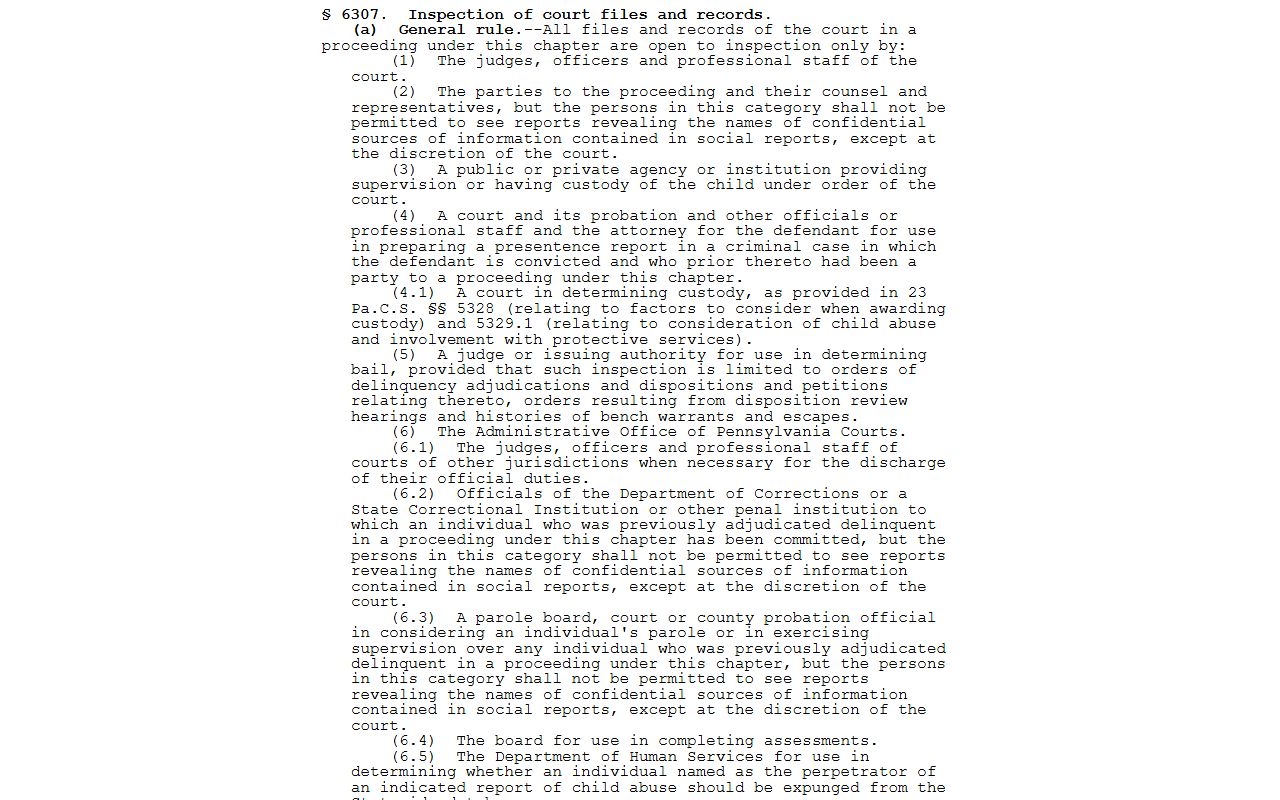
That restriction is relevant when a guardianship, minor, juvenile, or protected-person issue appears near an Orphans' Court record.
Filing Lawrence County Estate Records
A basic estate starts with the county where the decedent was domiciled. If the decedent lived in Lawrence County, the person opening the estate should contact the Register of Wills. If a will exists, the original will is usually part of the filing. If no will exists, the estate may proceed as intestate and the office may issue letters of administration to the proper personal representative.
Estate flow: Determine will status › contact the Register of Wills › file required estate papers › receive letters if accepted › give notices and handle assets › file inventories or required documents › resolve contested matters in Orphans' Court if needed.
Contested estates need more than a counter request. A will contest, account dispute, trust question, or guardianship challenge may require petitions, notices, hearings, and judge orders. Public docket sheets can show filing activity, but the underlying papers may require an office request and may be limited by court rule.
Lawrence County Probate Fees
The research did not locate confirmed Lawrence County probate fee amounts in official sources. Exact costs should not be guessed. Probate fees can depend on the filing type, estate value, number of short certificates, certification, exemplification, and whether the matter is an estate, guardianship, or other Orphans' Court filing.
| Item | Fee Status |
|---|---|
| Probate petition or estate opening | Amount not located in official sources during research. |
| Short certificate | Verify current Register of Wills fee schedule. |
| Certified estate copy | Verify current copy and certification charge with the office. |
| Guardianship filing | Amount not confirmed in official Lawrence County materials. |
| Marriage license | Handled by the same office, but fee not confirmed in research. |
Note: If a fee is not posted in the official source, confirm it with the office before mailing a check or money order.
Some statewide systems are useful only by contrast. The manifest image from the Pennsylvania Department of Corrections helps separate probate records from custody records.
Probate files are not jail or state-prison records, even when a death, guardianship, or family issue also leads someone to search other public systems.
Restricted Lawrence County Probate Records
Estate records are often more public than adoption, juvenile, mental-health, and some guardianship records. Pennsylvania law makes adoption records confidential. Juvenile court files and records also have limited public access. A public docket may reveal that a matter exists while hiding names, addresses, minor information, reports, or sealed pleadings.
For public copies, ask the Register of Wills or Orphans' Court office what can be released. For restricted records, access may require party status, attorney authority, statutory authorization, or a court order. A public-records request is not a shortcut around sealed case material. The Pennsylvania court public access policy controls case-record redactions, while the Right-to-Know Law is mainly used for agency records rather than sealed judicial case files.