
Lawrence County Arrest Records and Court Charges
Arrest records document the law-enforcement side of an event: the person arrested, agency involvement, custody or booking information, and related identifiers that may be held by the jail or law-enforcement agency. Court charge records document the accusation filed in court. In Lawrence County, the first public court charge record may be a Magisterial District Judge docket showing a complaint, preliminary arraignment, bail, preliminary hearing, and charge list.
If the charges are held for court, the case can move to the Lawrence County Court of Common Pleas, where the Clerk of Courts maintains the criminal file. The full outcome, including pleas, motions, disposition, and sentence, belongs in the criminal court record. For custody status or jail booking details, the separate inmate records route is more useful. For charges after arrest, the main path is UJS MDJ dockets first, then Common Pleas criminal dockets when applicable.
Find Lawrence County Arrest Records and Charges
There is no confirmed official Lawrence County public mugshot or booking database in the research materials. The official court-charge path is the Pennsylvania Unified Judicial System portal, with MDJ dockets for new or preliminary charges and Common Pleas dockets for cases held for court. The Lawrence County Jail, Sheriff, and court offices may hold related records, but each office handles a different part of the arrest-to-court process.
- Search the UJS MDJ docket sheets by defendant name, docket number, county, court office, or filing date.
- Review the charge list, statute, grade, bail entries, preliminary hearing events, and disposition at the MDJ level.
- Check whether the charges were held for court, dismissed, withdrawn, or otherwise resolved.
- If held for court, search the Common Pleas criminal docket for the later case file and outcome.
- Contact the Clerk of Courts for certified Common Pleas criminal copies when public docket data is not enough.
The UJS portal is the statewide starting point shown below. The source is the Pennsylvania Unified Judicial System portal, which supports the public path from a Lawrence County arrest-related charge to a docket sheet.
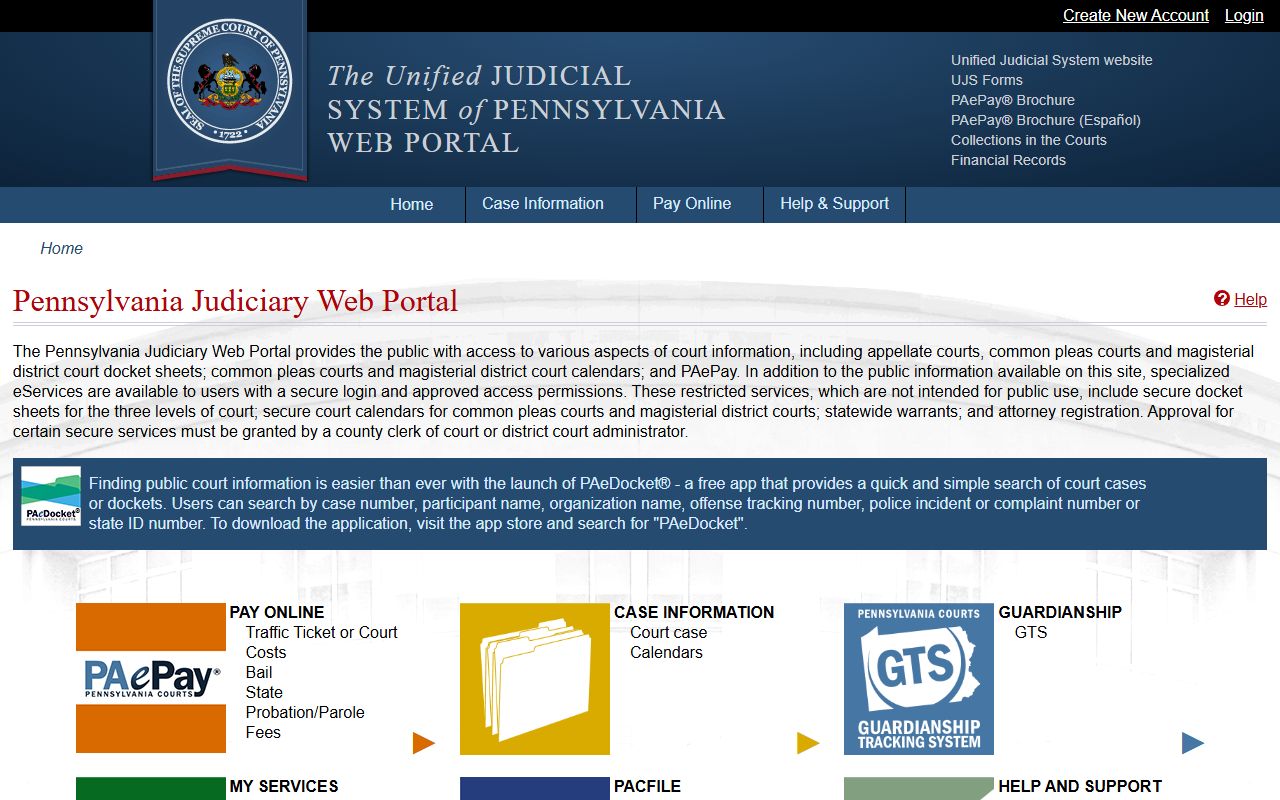
The portal identifies court activity. It does not replace jail custody records, police incident reports, or certified criminal-history products.
Charges Filed After Arrest
Charges after arrest enter the court record through charging documents. Pennsylvania county practice commonly uses a criminal complaint at the early stage and an information when the prosecutor files formal Common Pleas charges. Indictments are less common in ordinary county practice, but the term still matters because it describes a grand-jury charging document.
| Document | Who Files It | Where It Fits | What It Shows |
|---|---|---|---|
| Complaint | Law enforcement or prosecutor | Often appears at the MDJ stage. | Initial offense allegations, statute, grade, and incident basics when public. |
| Information | District Attorney | Common Pleas criminal case after charges are held for court. | Formal charges the prosecutor pursues in the county trial court. |
| Indictment | Grand jury | Less common in routine Pennsylvania county practice. | Grand-jury accusation for a criminal offense. |
Lawrence County Charge Status
Charge status is the most important part of an arrest-to-court search. One arrest can produce several charges, and each charge can have a different path. A docket may show that one count was held for court, another was dismissed, and another was amended. The current status should be read with the disposition and sentence, not from the first charge line alone.
| Status | What It Means |
|---|---|
| Pending | The court has not entered a final public outcome for the charge. |
| Held for court | The MDJ sent the charge forward to Common Pleas for prosecution. |
| Amended or reduced | The charge changed from the original accusation, often by count, grade, or statute. |
| Withdrawn or dismissed | The charge did not move forward or was removed by court action. |
| Nolle prosequi | The prosecutor declined to proceed on the charge, subject to court procedure. |
| Disposed | The charge has a recorded outcome such as guilty, not guilty, dismissed, or other court disposition. |
Charges vs Convictions
Being charged is not the same as being convicted. Lawrence County arrest records and charge records can show accusations that never become convictions. A charge may be reduced, dismissed, withdrawn, or resolved through a plea to a different count. A conviction appears only after a guilt-based outcome is entered by plea, verdict, or other qualifying disposition.
| Point | Charge | Conviction |
|---|---|---|
| Meaning | An accusation filed after an incident or arrest. | A final court outcome based on guilt. |
| Record location | Complaint, MDJ docket, information, or Common Pleas docket. | Disposition, plea, verdict, sentence, and financial entries. |
| Public use | Shows what was alleged and how charges changed. | Shows the legal outcome and sentence exposure. |
| Risk of misread | High if the docket is not read through disposition. | High if later appeal, expungement, or limited access is missed. |
Charge Codes and Severity
Charge lines often include an offense title, statute citation, grade, count number, and disposition. Grades help identify severity, such as felony, misdemeanor, or summary offense categories in Pennsylvania practice. A public docket may also show an offense tracking number, complaint number, arresting agency, incident number, bail status, and financial fields when those items are public.
Read each count separately. A docket with several charges is not one single allegation. It may include different statutory sections, different grades, and different outcomes. The formal Common Pleas information can differ from the first complaint because prosecutors review the case after arrest, preliminary proceedings, evidence review, plea talks, or court rulings.
Note: The first charge listed after arrest may not be the charge that controls the final case outcome.
Sealed vs Expunged Charge Records
Public access can change after a charge record is created. Pennsylvania law allows expungement for certain qualifying criminal-history records, and juvenile records have their own expungement rule. Sealed or limited-access records may still exist for courts or agencies but be hidden from public searches. That makes docket status and later orders important when reading old Lawrence County arrest records and charges.
| Point | Sealed or Limited Access | Expunged |
|---|---|---|
| Public visibility | Public access is blocked or narrowed. | The qualifying record is removed or destroyed as ordered. |
| Legal source | Court policy, confidentiality rule, or court order. | 18 Pa.C.S. section 9122 or juvenile expungement law when eligible. |
| Practical effect | A public search may omit documents or show limited entries. | The charge may no longer appear in normal public court searches. |
The image below comes from 18 Pa.C.S. section 9123, the Pennsylvania juvenile-record expungement statute. It is relevant because juvenile charge records are treated differently from ordinary adult public dockets.
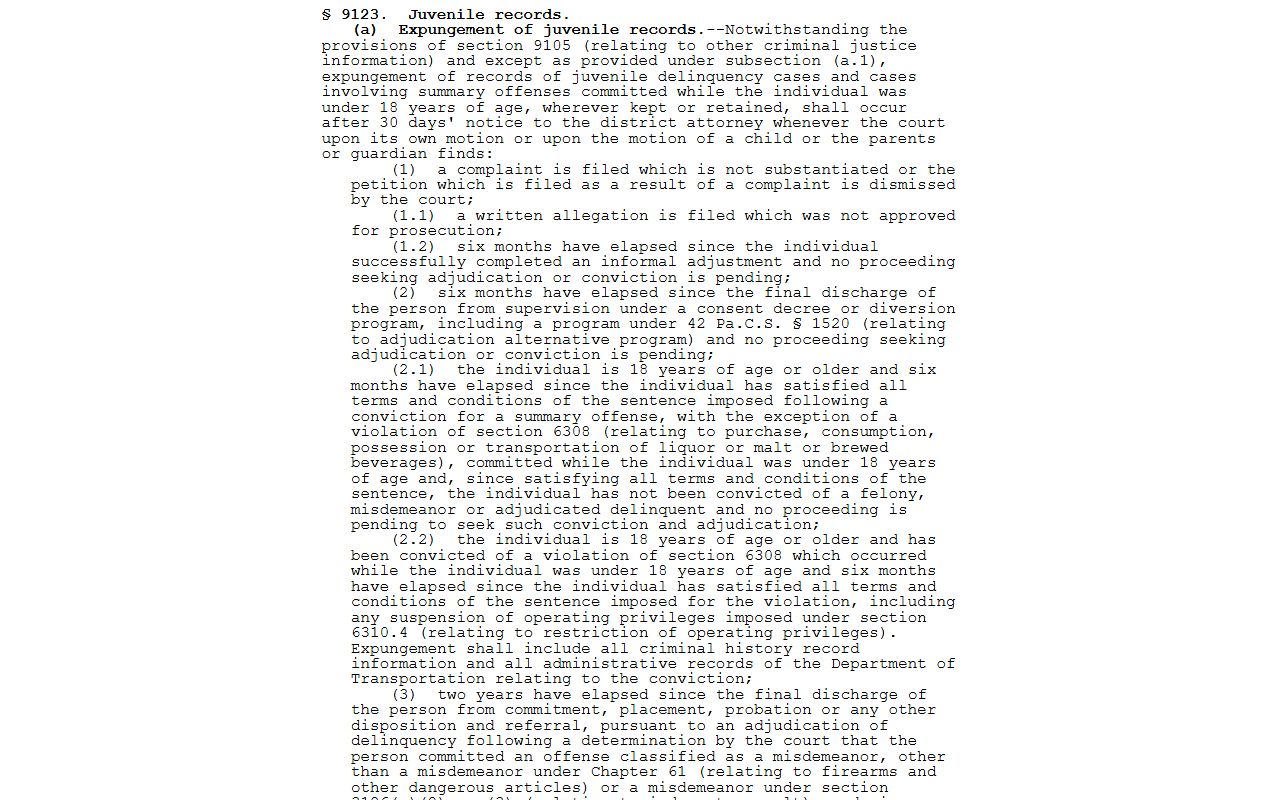
Adult and juvenile charge records should not be mixed. Juvenile access is limited, and public search gaps may reflect legal restrictions rather than missing data.
Public Access to Lawrence County Charges
Lawrence County charge records on public dockets are subject to Pennsylvania's court public-access policy. Public docket sheets can show charges, statute citations, grades, dispositions, bail entries, sentence details, costs, fines, and restitution when those fields are public. Protected identifiers, juvenile details, sealed items, mental-health information, victim addresses, and confidential contact information may be redacted or withheld.
The Right-to-Know Law can help with some agency records, but court case files are primarily handled under judicial public-access rules and through the court office that maintains the case. If the question is the formal court charge or disposition, start with UJS and then the Clerk of Courts or MDJ office. If the question is booking status, jail custody, or notification, use jail, DOC, and VINE channels instead.
District Attorney and Defense Context
The Lawrence County District Attorney is the prosecutor for Common Pleas criminal cases and works with law-enforcement agencies on charging decisions, plea negotiations, trial preparation, sentencing, victim communication, and post-conviction matters. That office's role explains why a docket caption often reads Commonwealth of Pennsylvania versus the defendant. The Public Defender's Office represents eligible defendants who cannot afford counsel, but it does not serve as a public charge-record lookup counter.
Victim services may help victims follow court dates, restitution, impact statements, notification rights, and safety concerns. For custody notifications, Pennsylvania VINE is the statewide route documented in the research. For a defendant, attorney advice is important before contacting the court about active charges, warrants, bail, or revocation entries.
Restricted Lawrence County Charge Records
Restricted charge records include juvenile charges, sealed warrants, sealed criminal cases, expunged charges, active investigative information, mental-health records, protected personal identifiers, and confidential victim data. A docket may also show a warrant, bail, or disposition entry without enough detail to explain the next legal step. The issuing court controls the case status.
When a person believes a charge or arrest record is wrong, incomplete, or eligible for expungement, the first task is to identify every docket involved. That may include an MDJ docket and a Common Pleas docket. Certified copies of any order that seals, limits, or expunges a charge should be kept because public systems and outside background data may not update at the same pace.
Public Record Search
Sponsored Results