
Lawrence County Criminal Court Records
Criminal court records in Lawrence County begin at more than one level. A new criminal matter may first appear in a Magisterial District Judge docket after arrest or citation, with preliminary arraignment, bail, and preliminary hearing entries. If the charge is held for court, the case moves to the Lawrence County Court of Common Pleas, Pennsylvania's 53rd Judicial District. The Common Pleas criminal file is maintained by the Clerk of Courts, not the Prothonotary.
The Common Pleas criminal record can show the information filed by the District Attorney, formal arraignment, pretrial motions, hearing events, plea entries, trial activity, verdict, disposition, sentencing order, fines, costs, restitution, bail-related entries, revocation filings, and appellate notices. For the narrower arrest-to-charge path, use the court charge page; for broad civil, family, probate, and traffic access, use the main Lawrence County court records page.
Search Lawrence County Criminal Court Records
The main public search route is the Pennsylvania UJS Case Search. Search Common Pleas docket sheets for criminal cases that have moved into the county trial court. Search MDJ docket sheets for recent arrests, summary offenses, preliminary hearings, bail settings, and charges that may not yet have a Common Pleas docket. A person arrested in New Castle or elsewhere in Lawrence County may have an MDJ docket before any Common Pleas file exists.
- Search by docket number first if the citation, complaint, notice, or attorney letter lists one.
- Choose Lawrence County and the correct court level: MDJ for early and summary matters, Common Pleas for county criminal files.
- Open the docket sheet and review charges, hearings, bail, docket entries, plea, disposition, sentence, and financial lines.
- Check for a linked or related docket when a matter moves from MDJ to Common Pleas.
- Request certified copies from the Clerk of Courts when the public docket is not enough.
Statewide criminal-history reports and public court dockets are not the same thing. A docket sheet shows court activity in a case. A formal criminal-history product may use law-enforcement repositories and different statutory rules. For custody status, use jail, DOC, or VINE resources rather than treating a criminal docket as a live inmate roster.
Lawrence County Criminal Case Flow
A Lawrence County criminal case can move through several public stages. Some stages happen in MDJ court, while others occur in Common Pleas. The public record may therefore be split. Reading only one docket can miss the beginning or later outcome of the case.
Case flow: Arrest or citation › Preliminary arraignment › Preliminary hearing › Information filed › Arraignment › Pretrial and motions › Plea or trial › Disposition › Sentencing
| Stage | What Happens |
|---|---|
| Preliminary arraignment | An MDJ may address early charges, bail, and release conditions. |
| Preliminary hearing | The MDJ decides whether charges move forward to Common Pleas. |
| Information filed | The prosecutor files the formal Common Pleas charging document. |
| Pretrial / motions | Attorneys file requests, notices, continuances, suppression motions, or other public entries. |
| Plea or trial | The defendant may plead, proceed to trial, or have charges resolved by other disposition. |
| Sentencing | The court enters sentence, costs, fines, restitution, probation, incarceration, or other orders. |
What Lawrence County Criminal Records Show
The public criminal docket is a field-by-field summary of the case. It can show criminal charge information, court events, counsel, bail, dispositions, and sentence data. It may also show financial obligations such as costs, fines, restitution, payments, and balances. Sensitive identifiers, juvenile information, sealed items, and protected victim data should not be expected in the public view.
| Field | What It Shows |
|---|---|
| Docket number | The Common Pleas or MDJ case identifier tied to Lawrence County. |
| Defendant | The accused person listed in the public criminal case caption. |
| Charges | Offense title, statute citation, grade, count, and charge disposition when public. |
| Arresting agency | The agency tied to the complaint or incident when shown on the docket. |
| Bail | Bail setting, bond status, forfeiture, or modification entries when public. |
| Plea | The defendant's formal response or plea outcome when entered. |
| Disposition | The result of a charge or case, such as guilty, dismissed, withdrawn, acquitted, or other outcome. |
| Sentence | Probation, incarceration, fines, costs, restitution, or related court orders when public. |
The image below is from 18 Pa.C.S. section 9122, Pennsylvania's criminal-history expungement statute. It matters because a Lawrence County criminal court record that once appeared publicly may later be removed or limited if a qualifying expungement order is granted.
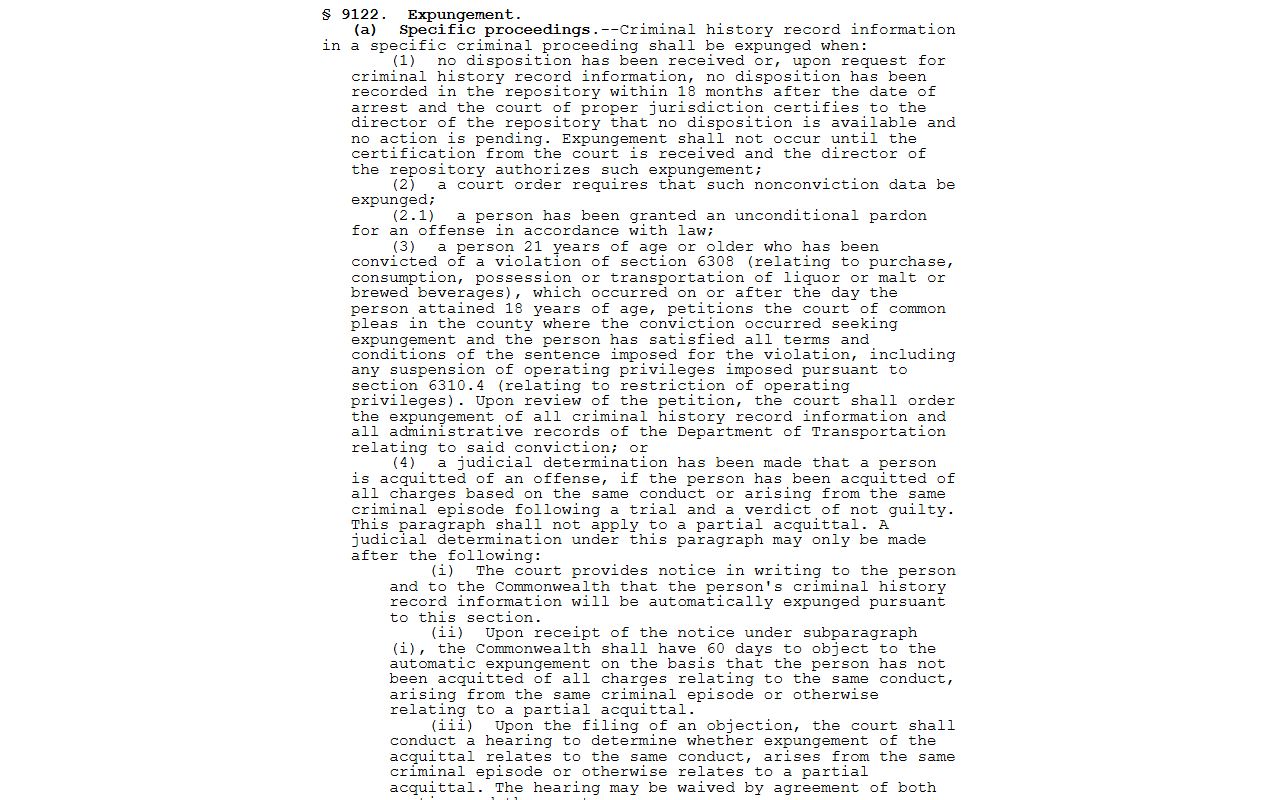
Expungement is case-specific. Users should identify every related MDJ and Common Pleas docket before assuming one order affected all public entries.
Charges vs Convictions
A criminal charge is an accusation filed in court. A conviction is an outcome after a guilty plea, verdict, or other conviction-producing disposition. Lawrence County criminal court records may show charges that were amended, reduced, dismissed, withdrawn, or resolved differently from the first complaint. That is why the disposition column matters as much as the original charge list.
| Point | Charge | Conviction |
|---|---|---|
| Meaning | An allegation filed by law enforcement or the prosecutor. | A final guilt-based outcome entered by the court. |
| Where it appears | Complaint, information, MDJ docket, or Common Pleas docket. | Disposition, plea, verdict, sentence, and financial entries. |
| Can change | Yes, charges may be added, amended, reduced, withdrawn, or dismissed. | Yes, later appeals, expungement, or limited access may affect public view. |
Dispositions and Sentences
Disposition means the outcome of a charge or case. In Lawrence County criminal dockets, a disposition should be read charge by charge. One count may be dismissed while another count results in a guilty plea. A sentence is the court order after conviction, and it may include confinement, county or state supervision, probation, fines, costs, restitution, no-contact conditions, treatment terms, or other requirements.
Financial entries can remain active after the case disposition. Costs, fines, restitution, and balances may appear in public docket fields. Bench warrants or probation violation entries may also appear later if a defendant misses court, violates a sentence, or fails to satisfy court obligations. The Clerk of Courts is the local Common Pleas criminal custodian for certified copies and criminal financial entries.
Sealed vs Expunged Criminal Records
Restricted criminal records are not all restricted in the same way. A sealed or limited-access record may still exist for court or agency purposes but be hidden from ordinary public searches. An expungement is a legal removal or destruction process for qualifying criminal-history records. Pennsylvania also has separate juvenile expungement rules and strict limits on juvenile files.
| Point | Sealed or Limited Access | Expunged |
|---|---|---|
| Public visibility | Hidden or limited from public view. | Removed or destroyed for qualifying records. |
| Access after order | Certain courts or agencies may retain access. | Access is more limited and depends on statute and order terms. |
| Common source | Court order, confidentiality rule, or limited-access law. | 18 Pa.C.S. section 9122 or juvenile expungement rules where eligible. |
Public Access to Lawrence County Criminal Records
Criminal docket sheets are broadly public through UJS, but Pennsylvania's case-records public access policy requires redactions and excludes confidential categories. Juvenile files are restricted by 42 Pa.C.S. section 6307. Criminal-history expungement is addressed by 18 Pa.C.S. section 9122, and juvenile expungement is addressed by 18 Pa.C.S. section 9123.
Note: A docket may show a public criminal case while still hiding sealed documents, protected identifiers, or juvenile information.
Restricted Lawrence County Criminal Records
Restricted criminal records include juvenile matters, sealed cases, expunged charges, mental-health-related records, confidential addresses, and protected victim information. Active investigations and sealed warrants may also be omitted or limited. Public searches should not be used to conclude that a record does not exist when the case type is one that Pennsylvania law restricts.
People with pending charges should use counsel or the assigned court office for case-specific instructions. The Public Defender's Office may assist eligible defendants, while the District Attorney handles prosecution and victim-related communications. Those offices do not serve as general public-record search services, but their roles explain why criminal dockets use the caption Commonwealth of Pennsylvania versus the defendant.
Public Record Search
Sponsored Results