
Lawrence County Prothonotary Office
The Prothonotary is the civil clerk for the Lawrence County Court of Common Pleas. Pennsylvania's office names can confuse people who expect one county clerk to hold all court files. In Lawrence County, the Prothonotary handles civil Common Pleas records. Criminal Common Pleas records are kept by the Lawrence County Clerk of Courts, and estate or Orphans' Court records are handled by the Register of Wills and Clerk of Orphans' Court.
Civil records can include complaints, answers, motions, court orders, judgments, liens, execution filings, satisfactions, divorce dockets, custody filings, and protection-from-abuse civil matters. Public docket information may be available through Pennsylvania's statewide court system, but certified copies and older paper records often require the local Prothonotary office.
Lawrence County Prothonotary
Lawrence County Government Center
430 Court Street
New Castle, PA 16101
(724) 658-2541
County hours: Monday-Friday 8:00 a.m. to 4:00 p.m.
Lawrence County Civil Records
The Prothonotary page should stay civil-only because Lawrence County uses a split-clerk structure. Civil Common Pleas case files are distinct from criminal files, traffic citations, MDJ preliminary criminal matters, and probate estates. A civil docket may show the caption, filing date, case status, attorney appearances, service entries, judgments, orders, and satisfaction filings. The public docket sheet is useful, but it is not always the same as the complete document file.
- Civil complaints, answers, motions, orders, and judgments.
- Divorce, custody, and protection-from-abuse civil filings where public access is allowed.
- Liens, execution papers, judgment satisfaction entries, and related civil docket activity.
- Certified civil copies requested for official use, title work, appeal packets, or personal records.
- Older or locally indexed civil files that may not appear fully in an online search.
Some family and protection-from-abuse records contain confidential details. Public docket access can be limited where minor information, protected addresses, abuse-victim data, sealed pleadings, or court-restricted documents are involved.
Federal court images assigned to this page help mark the boundary between Lawrence County civil records and federal case systems. The U.S. District Court for the Western District of Pennsylvania is separate from the county Prothonotary.
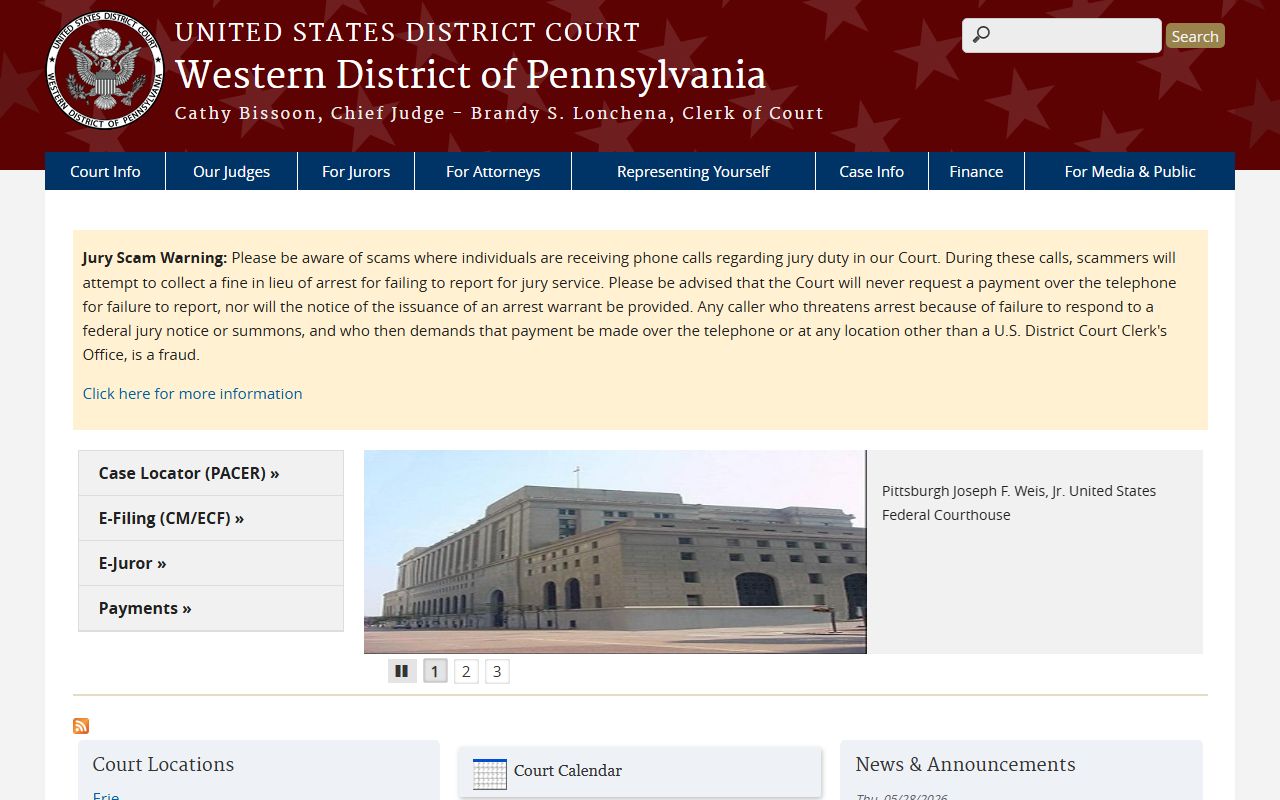
A Lawrence County civil judgment or divorce filing belongs in Common Pleas, while federal civil-rights, federal-question, diversity, and federal criminal matters use the federal district court.
Search Lawrence County Prothonotary Records
The main online route for public civil docket information is the Pennsylvania Unified Judicial System. Use the Common Pleas docket-sheet search or Case Search, choose Lawrence County, then search by docket number or participant name. A docket number is best because statewide name searches can return many people and cases. If the online docket does not show the record, call or visit the Prothonotary because older records may be paper or locally indexed.
- Open UJS Case Search or the Common Pleas docket-sheet search.
- Select the Common Pleas level and narrow the county to Lawrence when the field is available.
- Enter the civil docket number if known, or search by participant name and filing period.
- Open the docket sheet and review parties, entries, orders, judgments, and status.
- Contact the Prothonotary for certified copies or documents that are listed but not downloadable.
Divorce decree requests should include the case number, both party names, the approximate filing year, and whether certification is needed. For a broader search across civil, criminal, traffic, and probate topics, use the main Lawrence County court records overview to route the request to the right office.
Lawrence County Civil Request Fields
No Lawrence County universal court-record request form was located in official sources. A clear written request should still follow a consistent set of fields. That helps the Prothonotary identify the civil record, quote copy costs if needed, and decide whether the requested document can be released to the public.
| Field | Required | Notes |
|---|---|---|
| Requester name and contact | Yes | Include mailing address, email, and phone for payment or pickup questions. |
| Case number | No | Strongly preferred because it avoids broad name-search problems. |
| Party names | Yes | Use full names for plaintiffs, defendants, spouses, petitioners, or respondents. |
| Record title | Yes | Name the decree, judgment, complaint, order, lien, or docket sheet requested. |
| Certification need | Yes | State whether a plain copy or certified copy is needed. |
| Delivery method | Yes | Ask whether pickup, mail, or another approved method is available. |
Request Certified Civil Copies
Certified civil copies are used when a person must prove that a record is an official court document. Common examples include divorce decrees, judgment records, court orders, and civil docket entries needed for another agency or proceeding. A public online docket printout may be useful for reference, but it may not satisfy a certified-copy requirement.
- Locate the civil docket number through UJS or from old court papers.
- Call or visit the Prothonotary to confirm the document title and whether it is public.
- Ask for the current copy, certification, mailing, and payment requirements.
- Submit the request with party names, filing year, certification need, and return contact.
- Keep the receipt and note whether the office will mail the copy or hold it for pickup.
Note: A certified copy is different from a search result, and the office may need time to pull older files.
Electronic federal filing is not the county civil filing counter. The assigned image from Western District of Pennsylvania CM/ECF fits here because it shows a separate federal access channel.
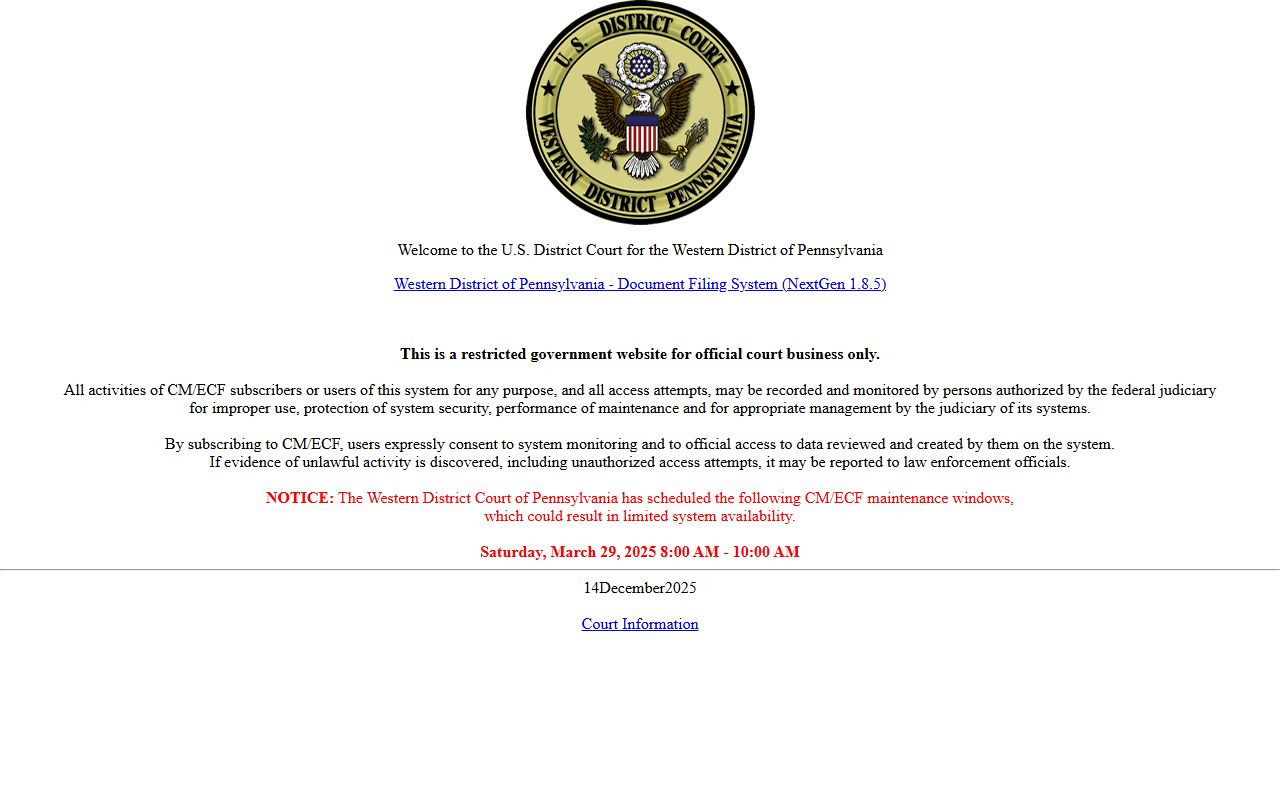
Use county Common Pleas and Prothonotary channels for Lawrence County civil files, not federal CM/ECF, unless the case was filed in federal court.
Lawrence County Prothonotary Fees
Official research did not locate confirmed Lawrence County Prothonotary copy or certification amounts. Exact fees should not be inferred from another county or from a private site. Civil fees can vary by filing type, copy count, certification, postage, and whether a search must be performed before a copy can be prepared.
| Item | Fee Status |
|---|---|
| Plain civil copy | Fee not located in official sources during research. |
| Certified civil copy | Verify current Prothonotary fee schedule. |
| Divorce decree copy | Verify copy and certification cost with the office. |
| Civil filing fee | Use the current Prothonotary schedule before filing. |
| Statewide docket search | Free public docket search; document copies are separate. |
Restricted Lawrence County Civil Files
Pennsylvania court records are public in many situations, but public access is not absolute. The court public access policy requires redaction of personal identifiers and limits confidential categories. Family records, protection-from-abuse filings, minor information, confidential addresses, sealed exhibits, financial account numbers, and certain sensitive pleadings may be withheld or released only in limited form.
The Pennsylvania Right-to-Know Law can help with some county agency records, but case records usually follow judicial access rules and the filing office's process. If a civil case is sealed, the Prothonotary cannot release sealed documents just because a person asks for a public-record copy. The requester may need party status, attorney authority, or a court order.
Federal public docket access through PACER is another separate system shown by the final assigned Prothonotary page image.
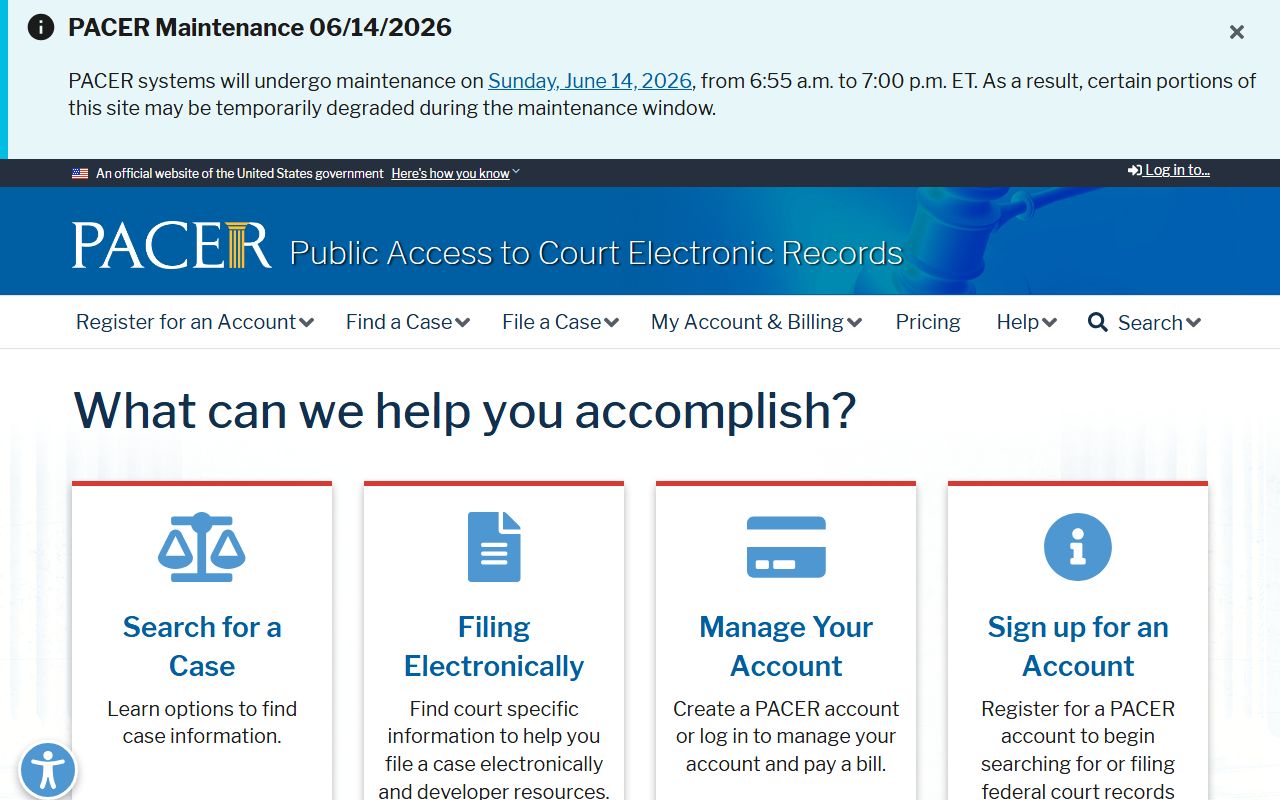
PACER can be relevant for federal civil or bankruptcy research, but it does not replace the Lawrence County Prothonotary for county civil Common Pleas records.
Lawrence County Clerk Split
Use the Prothonotary for civil Common Pleas files. Use the Clerk of Courts for criminal Common Pleas files, sentencing records, bail-related entries, and criminal financial obligations. Use the Register of Wills and Clerk of Orphans' Court for estates, wills, guardianships, adoptions within access limits, and marriage licenses. Use Magisterial District Judge offices for traffic, summary offenses, landlord-tenant cases, small civil claims, and new criminal preliminary matters.
This split saves time at the courthouse. A request for a criminal sentence sent to the Prothonotary may have to be redirected. A request for a divorce decree sent to the Clerk of Courts is also misrouted. When unsure, start with the docket number and case type, then match the record to the office that maintains that file.